Auditorily Embodied Conversational Agents: Effects of Spatialization and Situated Audio Cues on Presence and Social Perception
Yi Fei Cheng,
Jarod Bloch,
Alexander Wang,
Andrea Bianchi,
Anusha Withana,
Anhong Guo,
Laurie M. Heller,
David Lindlbauer.
Published at
ACM CHI
2026
Abstract
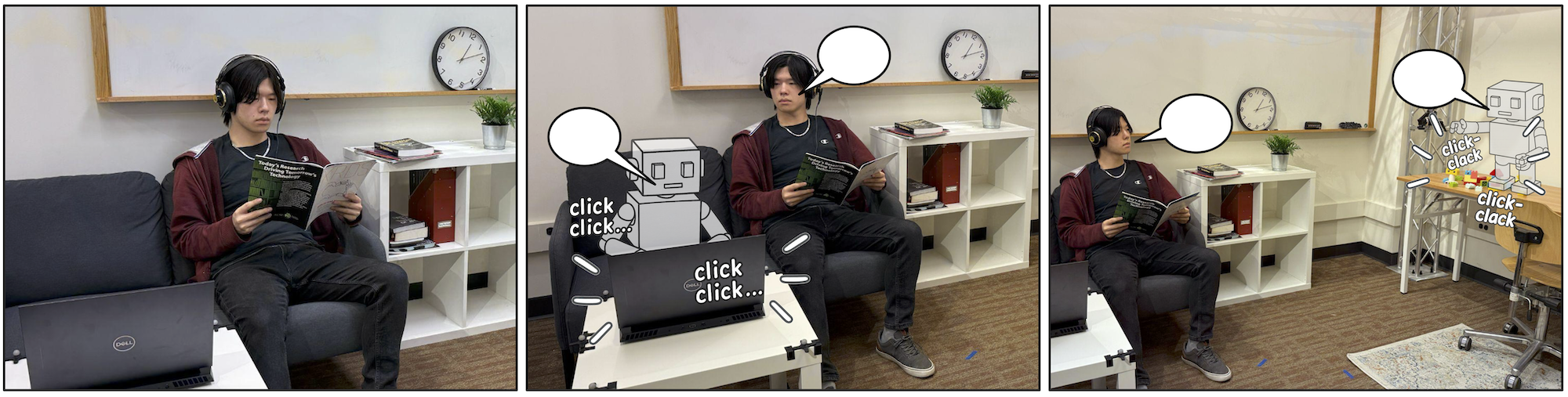
Embodiment can enhance conversational agents, such as increasing their perceived presence. This is typically achieved through visual representations of a virtual body; however, visual modalities are not always available, such as when users interact with agents using headphones or display-less glasses. In this work, we explore auditory embodiment. By introducing auditory cues of bodily presence -- through spatially localized voice and situated Foley audio from environmental interactions -- we investigate how audio alone can convey embodiment and influence perceptions of a conversational agent. We conducted a 2 (spatialization: monaural vs. spatialized) × 2 (Foley: none vs. Foley) within-subjects study, where participants (n=24) engaged in conversations with agents. Our results show that spatialization and Foley increase co-presence, but reduce users’ perceptions of the agent’s attention and other social attributes.
Materials
Bibtex
@inproceedings {Cheng2026AuditoryAgents,
 author = {Cheng, Yi Fei, and Bloch, Jarod and Wang, Alexander and Bianchi, Andrea and Withana, Anusha and Guo, Anhong and Heller, Laurie M. and Lindlbauer, David},
 title = {Auditorily Embodied Conversational Agents: Effects of Spatialization and Situated Audio Cues on Presence and Social Perception},
 year = {2026},
 publisher = {Association for Computing Machinery},
 address = {New York, NY, USA},
 doi = {10.1145/3772318.3791794},
 keywords = {Presence, Embodiment, Agents, Spatial Audio},
 location = {Barcelona, Spain},
 series = {CHI '26}
 }